Roberts Group: Meta-optics, nanophotonics, and imaging
Fabricating nanoscale structures from top down and bottom up enables unprecedented control of light.
From being able to enhance and modify emission from fluorescent molecules and quantum dots through the production of coloured surfaces using only metals, new applications in optical information processing, display technology and next-generation sensors emerge.
Research in this group is focused on the development of novel nanoscale wavefront sensing elements for phase imaging, producing plasmonic waveguides and integrated detectors and demonstrating metasurfaces to replace bulky optical components with ultra-compact elements.
The group is part of the ARC Centre of Excellence for Transformative Meta-Optical Systems (TMOS).
News
Contact
For enquiries, please email Prof Ann Roberts - ann.roberts@unimelb.edu.au
Meet the academics and researchers in the Roberts Group: Meta-optics, nanophotonics, and imaging.
Academic staff

Graduate researchers

Niken Priscilla

Lincoln Clark

Haiwei Wang

Gabriel Oyarzo Ojeda
Farid Khoshkhati
MSc Students

Kris Kariawan

Irene Silaen
Research projects in meta-optics, nanophotonics, and imaging.
Meta-optics
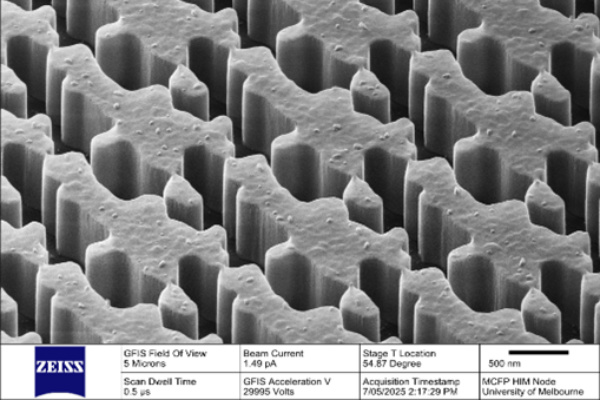
There is considerable excitement about the field of meta-optics which describes the use of novel materials and surfaces composed of subwavelength structures. These features interact with light to create a wide range of devices, some of which can replicate conventional optical components such as lenses but also others that manipulate light in ways that are not achievable using established optics. Furthermore, metasurfaces provide an avenue to create ultracompact optical components compatible with the contemporary drive to miniaturisation of electronic devices. Our group has demonstrated colour filters, polarisers, structures that can enhance and control the emission of light from quantum dots, and those that extend and enhance the performance of photodetectors.
Our work is part of the ARC Centre of Excellence for Transformative Meta-Optical systems where we collaborate with other centre members at nodes at Australian National University, RMIT University, University of Technology – Sydney and University of Western Australia and partners elsewhere in Australia and overseas.
Structural colouration
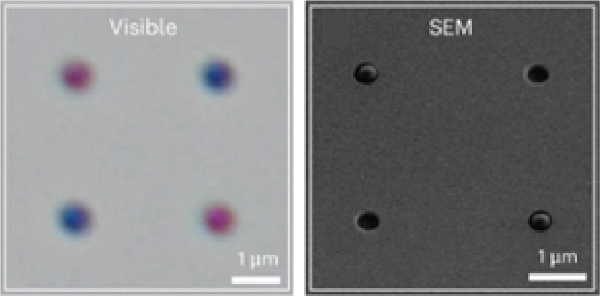
Throughout human history, humans have used colour for coding information, differentiating between objects and for entertainment. Most manufactured objects we perceive as possessing a particular colour have been coated with a pigment or impregnated with a dye. These, however, fade with time, can be toxic and their use adds an additional layer of complexity to manufacturing and subsequent recycling of materials. Consequently, there is considerable interest in being able to replicate the colour spectrum without the introduction of additional materials. We are undertaking research into creating structural colour in various ways.
One approach involves utilising localised plasmonic resonances in aluminium to create ‘plasmonic pixels’. Furthermore, colour carries a significant amount of information and we have demonstrated the use of colour in a photonic ‘sieve’ that can identify the presence of plastic nanoparticles and determine their size. We are also collaborating with researchers in the School of Biosciences, investigating structural colouration and light polarisation in beetles. Nature provides a dazzling example of structural colour and we are investigating its properties and potential for new bioinspired materials.

Tunable meta-optics
Once fabricated, the structures discussed above have fixed optical properties. In many applications, however, it is desirable to dynamically tune or switch their response, such as their colour or polarisation properties. This can be achieved through the introduction of materials that have optical properties that can be modified by changing their temperature or applying a voltage. We are investigating the introduction of materials such as ITO and vanadium dioxide into meta-optical components.
Imaging
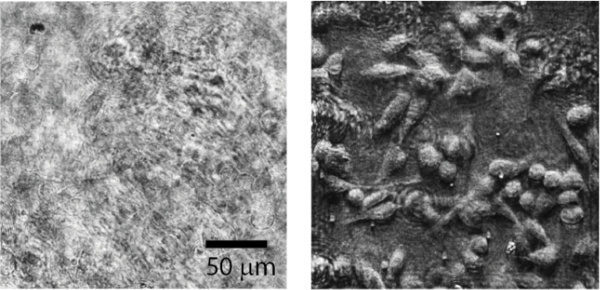
Members of the group have a strong interest in developing new imaging methods, particularly those leveraging the unique optical properties of metasurfaces. One primary application is to the visualisation of transparent optics such as biological cells. These are generally stained to provide the contrast required to be able to see images obtained with a camera, but this takes time and fundamentally alters the cell.
Using the wavefield manipulation properties of metasurfaces, we are able to convert the phase introduced into an optical wavefield by variations in thickness and refractive index within the sample to an easily imaged intensity map. This information can also be used to quantitatively recover the phase introduced by the object.
Selected publications from Roberts Group:
Meta-optics, nanophotonics, and imaging
To view a full list of publications
2026
- Wang, H., Ma, S., Sulejman, S., Priscilla, N., Lee, W. S. L., Elango, P. F. M., Wesemann, L., Hinde, E.; &Roberts, A. (2026). Wavelength and Polarization Multiplexed Nonlocal Metasurface for Quantitative Phase Microscopy. Nanophotonics 15 (13), e70190, doi: http://doi.org/10.1002/nap2.70190
- Ren, J., Ma, J., Tanaka, K., Wesemann, L., Roberts, A., Setzpfandt, F., & Sukhorukov, A. A. (2026). Quantum phase gradient imaging using a nonlocal metasurface system. Optica, 13 (5), 920-929. doi:10.1364/optica.586554
- Arslan, S., Sulejman, S. B., Klein, S., Haehner, J., Schwab, J., Ludescher, D., Wesemann, L., Roberts, A., Giessen, H & Hentschel, M. (2026). Polarization-Dependent Elliptical and Rectangular Mie Voids. Small, 22(21), 9 pages. doi:10.1002/smll.202511992
2025
- Ludescher, D., Wesemann, L., Schwab, J., Karst, J., Sulejman, S. B., Ubl, M., . . . Hentschel, M. (2025). Optical sieve for nanoplastic detection, sizing and counting. Nature Photonics. doi:10.1038/s41566-025-01733-x
- Sulejman, S. B., Wesemann, L., McCormack, M., Meng, J., Hutchison, J. A., Priscilla, N., . . . Roberts, A. (2025). Metasurfaces for Infrared Multimodal Microscopy: Phase Contrast and Bright Field. ACS Photonics, 12(3), 1494-1506. doi:10.1021/acsphotonics.4c02097
- Nath, S. K., Syed, N., Pan, W., Yu, Y., Liu, D., Nielsen, M. P., . . . Lei, W. (2025). Liquid Metal-Exfoliated SnO2-Based Mixed-Dimensional Heterostructures for Visible-to-Near-Infrared Photodetection. Advanced Optical Materials, 10 pages. doi:10.1002/adom.202500765
2024
- Syed, N., Nguyen, C. K., Zavabeti, A., Low, M. X., Wei, X., Krishnamurthi, V., . . . Daeneke, T. (2024). Vacuum-Free Liquid-Metal-Printed 2D Semiconducting Tin Dioxide: The Effect of Annealing. ACS Applied Electronic Materials, 9 pages. doi:10.1021/acsaelm.3c01842
- Cotrufo, M., Sulejman, S. B., Wesemann, L., Rahman, M. A., Bhaskaran, M., Roberts, A., & Alù, A. (2024). Reconfigurable image processing metasurfaces with phase-change materials. Nature Communications, 15(1). doi:10.1038/s41467-024-48783-3
- Ospina-Rozo, L., Medina, I., Hugall, A., Rankin, K. J., Roberts, N. W., Roberts, A., . . . Stuart-Fox, D. (2024). Polarization and reflectance are linked to climate, size and mechanistic constraints in a group of scarab beetles. Scientific Reports, 14(1). doi:10.1038/s41598-024-80325-1
- Priscilla, N., Sulejman, S. B., Roberts, A., & Wesemann, L. (2024). New Avenues for Phase Imaging: Optical Metasurfaces. ACS Photonics, 11(8), 2843-2859. doi:10.1021/acsphotonics.4c00359
- Nguyen, C. K., Taylor, P. D., Zavabeti, A., Alluhaybi, H., Almalki, S., Guo, X., . . . Syed, N. (2024). Instant-in-Air Liquid Metal Printed Ultrathin Tin Oxide for High-Performance Ammonia Sensors. Advanced Functional Materials, 12 pages. doi:10.1002/adfm.202309342
- Priscilla, N., Wesemann, L., Clark, L., Sulejman, S. B., Rickett, J., Davis, T. J., & Roberts, A. (2024). Rapid inverse design of metasurfaces with an asymmetric transfer function for all-optical image processing using a mode matching model. Optics Express, 32(15), 26964-26978. doi:10.1364/OE.521874
- Syed, N., Bonin, G. O., Kim Nguyen, C., Low, M. X., Meng, J., Zavabeti, A., . . . Roberts, A. (2024). Plasmonic Gold Nanoparticle-Decorated Ultrathin SnO2 Nanosheets with Superior Ultraviolet and Visible Photoresponsivity. ACS Applied Nano Materials, 7(10), 11184-11194. doi:10.1021/acsanm.4c00680