Mm-5 Hooke's Law and Horizontal Simple Harmonic Motion Using Pascar
Aim
To demonstrate Hooke's Law and Horizontal Simple Harmonic Motion Using Pascars.
Apparatus
- Pascar with Vector Display Unit
- Pascar Track
- Laptop Computer
- Capstone Software
- 2 Light Springs
Diagrams
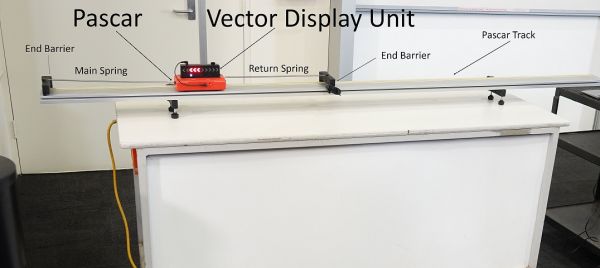
Setup
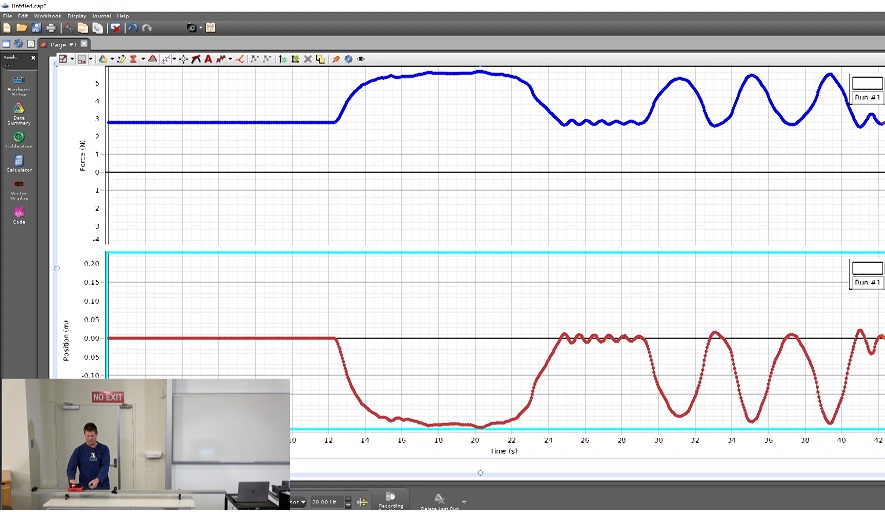
Force, Position v Time
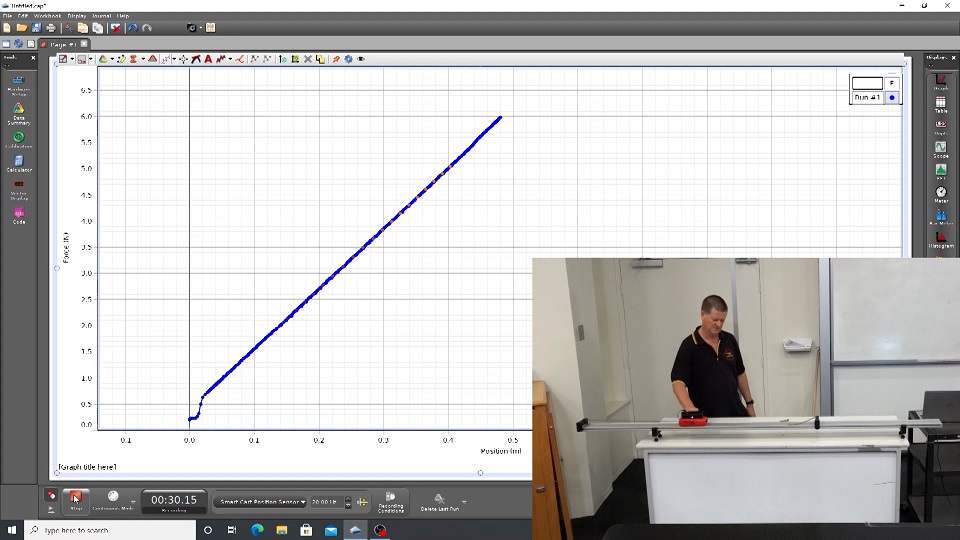
Force v Position
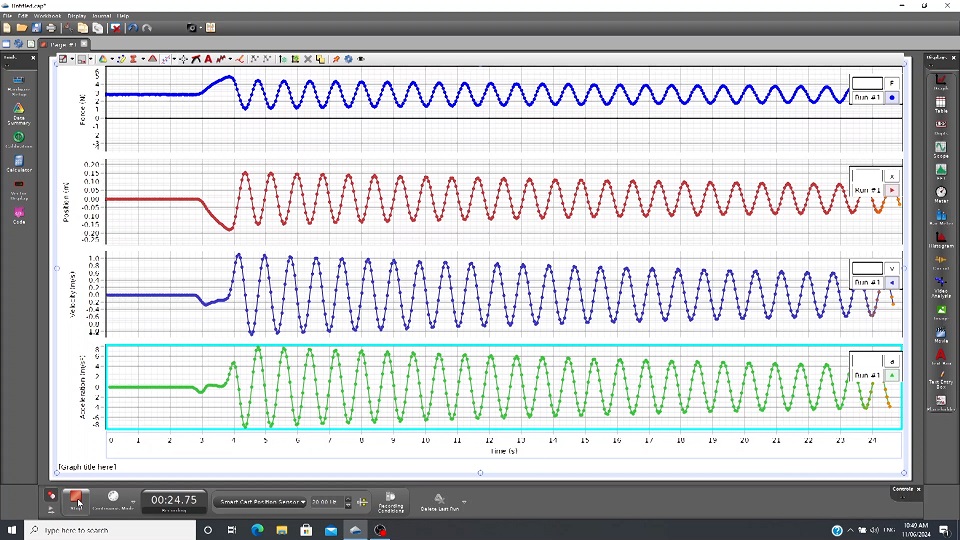
Force, Position, Velocity, Acceleration v Time
Description
The Pascar has an inbuilt Force Sensor and Accelerometer, also the position and velocity can be measure using Capstone Software. With the Pascar connect by a spring and to the end barrier of the Pascar Track. The Pascar can be moved by hand along the Track. The Vector Display is attached to the top of the Pascar. The Pascar is connected to the laptop via blue tooth. Graphs can be constructed by the Capstone software such as Force v Time, Force v Position, Force, Position, Velocity, Acceleration v Time. By running the software in record mode, we can observe various properties of the spring and simple harmonic motion from the graphs. When demonstrating Simple Harmonic Motion, we can attach a second spring to the Pascar to another end barrier, so the Pascar doesn’t fall off the Track.
We can analyse the properties of Hooke’s Law.
- That Hooke’s Law obeys the equation F=-kX.
We can also analyse the properties of Horizontal Simple Harmonic Motion.
- That Force and Position are 180° out of phase.
- That Velocity is at maximum when Acceleration is zero. When Acceleration is at a maximum the Velocity is zero.Which means they’re 90° out of phase.
- Force and Acceleration are in phase.