Hd-6 Heat Pump
AIM
To demonstrate the workings of a Heat Pump.
APPARATUS
- Heat Pump 3B Scientific
- 2 Room Temperature Water Reservoirs
 DESCRIPTION
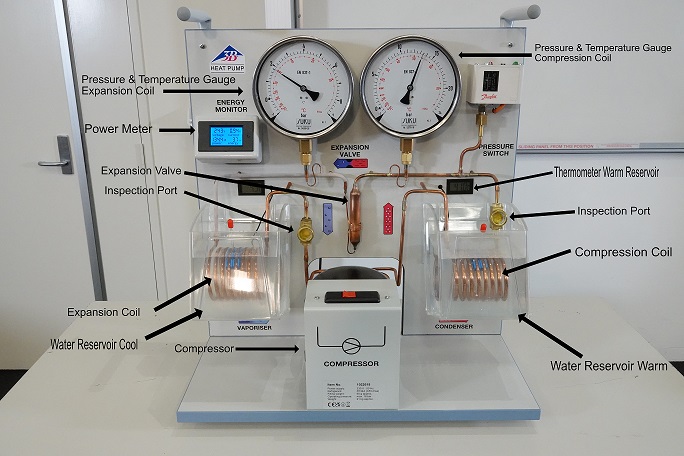
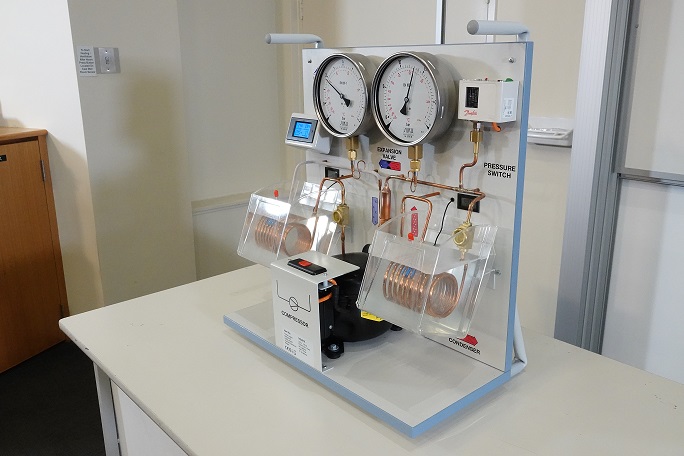
The Heat Pump consists of compressor that is connected to copper tubing that forms a circuit. The circuit consist of 2 coils that are immersed in water reservoirs that are initially at room temperature. In between the coils is an expansion valve. Also, on either side the expansion valve a pressure/temperature gauge is connected to copper tubing. There are also two thermometers that measure the temperature of the water reservoirs. The Compressor Copper tubing circuit contains the Refrigerant R134A (Tetrafluorethane C2H2F4 ) which has Boiling Point -26°C at 1 bar. 1 bar is close to 1 atmosphere. The circuit is completely sealed so no leakage can occur.
Initially the Heat Pump is started at room temperature. So, the Refrigerant R134A is in a gaseous state. Which is ideal condition state for the Compressor to do its work. Liquids are uncompressible. The Compressor compresses R134A which forces the gas into the Compression Coil via the copper tubing. R134A is compressed into a liquid/gas state, which also causes R134A to heat up. The Compression Coil is immersed in a Water Reservoir. The compressed heated liquid/gas state of R134A will release heat energy to the Water Reservoir. This process will cause more of liquid/gas state of R134A to become liquid. Also, the Water Reservoir will heat up. When you look at the inspection port above the Compression Coil, you should see liquid with a small amount of bubbles (gas) flowing through it.
The refrigerant R134A continues it’s journey to the Expansion Valve. The liquid R134A should expand into a gaseous state and cool at the same time. Not all the R134A will return to gaseous state, some of it will be liquid. The R134A will continue is journey to the Expansion Coil, which is immersed in a water reservoir. The R134A gas/liquid will absorb energy from the water reservoir, causing more of the gas/liquid mixture to become gas. The water reservoir will cool due to this process. If you look at the Inspection Port above Expansion Coil you see mostly gas as opposed to the Inspection Port above the Compression Coil.
The R134A will continue it’s journey back to the Compressor, mainly in a gaseous state. There is a small reservoir in the Compressor to allow the liquid R134A to return to a gaseous state, before being compressed again.
The process is continually being repeated.
This is the basis on which Air Conditioners, Refrigerators and Heat Pumps work on in domestic and industrial situations.
Observations
It takes a few takes a few minutes to notice the temperature difference between the water reservoirs to be 15°C. After about 20 minutes you notice a temperature difference of 30-40°C. With water reservoir temperature of the Expansion Coil being about 5°C, while the water reservoir temperature of the Compression Coil being 30-40°C.
The pressure difference on either side of the expansion will be 10-15 bar for the Compression Coil compared to 0-2 bar for the Expansion Coil. This corresponds to a temperature difference of 40-60°C compared to -10-0°C respectively.
On initially startup of the Heat Pump, the R134A in the Inspection Port on the Expansion Coil will be mainly gas. The longer you run the Heat Pump you will observe more liquid. This mainly due to the water reservoir cooling down.