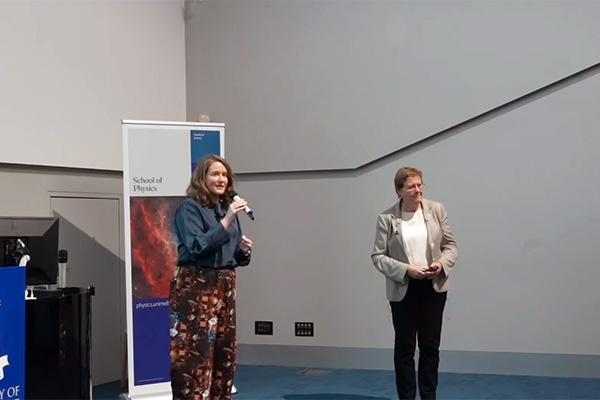
History of public lectures in physics
A timeline of every lecture and presenter.
Graham Sargood initiates the lecture series in 1968.
- 1968
-
Gravitation and inertia: How are they related? - Sargood, D.G.
Temperature: What is it? - Klein, A.G.
Electromagnetic Waves - Opat, G.I.
Particles and Waves: Can they be reconciled? - Wignall, J.W.G. - 1969
-
Atomic Structure: To what extent can we visualise it? - Sargood, D.G.
Bulk matter and atomic physics: How do they explain each other? - Opat, G.I.
Interference of light: How does it depend on coherence? - Klein, A.G.
Newtonian mechanics and relativity: How are they related? - Caro, D.E. - 1970
-
Light propagation: How is it influenced by matter? - Opat, G.I.
Temperature and thermal motion: Are they synonymous? - Sargood, D.G.
Kepler's Laws: Do astronauts obey them? - Klein, A.G.
They eye: What can it tell us about light? - Budwine, R.E. - 1971
-
Wave phenomena:: What have they in common? - Sargood, D.G.
Quantum effects: When are they important? - Thompson M.N.
Static electricity: How does it behave? - Klein, A.G.
Physical models: Can we trust them? - Amos, K.A. - 1972
-
Geometrical and Wave Optics: How are they unified? - Sargood, D.G.
Properties of matter: What is the inside story? - McKellar, B.H.J.
Electrons in solids: How do they behave? - Klein, A.G.
Iron: Why does it affect magnetic fields? - Opat, G.I. - 1973
-
Nuclear Radiations: How are they detected? - Sargood, D.G.
Transistors: How do they work? - Klein, A.G.
Matter waves: What waves? - Spicer, B.M.
Lasers: How do they work? - Opat, G.I. - 1974
-
The chemical elements: Where did they come from? - Sargood, D.G.
The sound of music: Is it physics? - Thompson, M.N.
Many body problems: What have they in common with elementary electrostatics? - Hines, K.C.
Charged particle trajectories: How are they exploited? - Opat, G.I. - 1975
-
Wave-Particle Duality: An impossible concept - Sargood, D.G.
Electronics and classroom demonstration - Klein, A.G.
Gravitation, Black Holes and all that - Opat, G.I.
From Red Shifts to Speed Traps: Uses of Doppler effect - Boydell, S.G. - 1976
-
Astronomy - Sargood, D.G.
Sound - Muirhead, E.G.
Properties of Solids - Opat, G.I.
Optical Instruments - Klein, A.G. - 1977
-
Atomic Nuclei: How do they behave? - Sargood, D.G.
Atoms in Solids: How well can we see them? - Spargo, A.E.C.
Electromagnetic Fields and Circuits: How are they related? - Klein, A.G.
Physical Principles applied to Biological Systems - Mason, G.C. - 1978
-
Fluctuations: The ultimate limits of measurement - Opat, G.I.
Matter and Antimatter - Wignall, J.W.G.
Quarks and Leptons - Tovey, S.N.
Energy Storage - Klein, A.G. - 1979
-
The Universe: Is it really expanding - Sargood, D.G.
Newton's "laws": Are they really? - Mason, G.C.
The earth's magnetic field: What is its origin? - Wignall, J.W.G.
X-rays and crystals: The story of a happy coincidence - Barnea, Z.
1980–1989
- 1980
-
Some paradoxes in elementary electromagnetism - Sargood, D.G.
Scaling Laws: Bigger isn't always better - McKellar, B.H.J.
Electric motors: No new twists - all torque - Klein, A.G.
Heat, entropy, and the energy problem - Opat, G.I. - 1981
-
Models and Analogies: The nitty-gritty of Physics - Sargood, D.G.
Light Propagation - How is it influenced by matter? - Opat, G.I.
Radiation and its interaction with matter - Klein, A.G.
Nuclear Physics and the measurement of time - Bolotin, H.H. - 1982
-
Centrifugal force and all that - Sargood, D.G.
Is the proton really stable? - Tovey, S.N.
From particles to waves - Klein, A.G.
Transducers - from physical effects to electrical measurements - Opat, G.I. - 1983
-
Waves in the environment - Wignall, J.W.G.
Diffraction image formation, and holography - Spargo, A.E.C.
Symmetries in mechanics - Opat, G.I.
Origin of the elements - Sargood, D.G. - 1984
-
The Chinese Typewriter: A successful application of Science to the Chinese puzzle - Barnea, Z.
Geometrical Optics: Why does it work and when does it not work? - Sargood, D.G.
Temperature: What is it? - Klein, A.G.
Sound: Its generation, transmission, and reception: The ear and the voice - Opat, G.I. - 1985
-
Nuclear Energy: what are the facts? - Sargood, D.G.
Determination of Newton's Gravitational Constant: the problem of measuring small forces - Opat, G.I.
Sources of light: their Physics and Technology - Klein, A.G.
Physics alive: A medley of demonstration experiments - Amos, K.A. - 1986
-
Radiation: What is it? How is it made? What does it do? - Sargood, D.G.
Sixty years of Quantum Mechanics - Opat, G.I.
Phosphorescence, fluorescence, and luminescence - Klein, A.G.
Waves and communication: a demonstration lecture - Amos, K.A. - 1987
-
Evolving Stars and Supernovae - Sargood, D.G.
Superconductivity - Opat, G.I.
Optical Communications - Klein, A.G.
Images without lenses - Nugent, K.A. - 1988
-
Chernobyl: What actually happened - Sargood, D.G.
The elusive Neutrino - Taylor G.N.
Pythagoras and twentieth-century Physics - Opat, G.I.
Optical Fibres for measuring and sensing - Klein, A.G. - 1989
-
The Mysterious Coriolis Force - Sargood, D.G.
Ceramics for nuclear waste management - White, T.J.
Rainbows, halos, and glories - Klein, A.G.
Quantum tunnelling: Doing the impossible - Opat, G.I.
1990–1999
- 1990
-
David Jamieson takes the helm in 1990.
What is so special about the speed of light? - Sargood D.G.
Why do magnetic forces depend on who measures them? - Jamieson D.N.
Image processing: Sharp prints from blurred originals, and other matters - Wood G.J.
The fractal geometry of nature: an illustrated talk - Taucher, T.C., Griffin C.J. and Bardos, D.C. - 1991
-
The unity of physics: Experimental demonstrations - Sargood, D.G.
Light in focus: 600 million years of progress - Jamieson, D.N.
Michael Faraday: 200 years on - Klein, A.G.
Pressure: From Archimedes to lasers - Opat, G.I. - 1992
-
A quark of nature: Elementary particles and the universe - Volkas, R.R. and Taylor, G.N.
Electro-optics: From electronics to photonics - Roberts, A.
The PC as a window on the cosmos - Jamieson, D.N.
Research in the School of Physics: Towards the 21st Century - Klein, A.G. - 1993
-
How does it work? Physics in everyday technology - Klein, A.G.
Energy for the future: The Physics of sustainablesources - Hollenberg, L.C.L.
Microscopy with protons: New ways of seeing - Jamieson, D.N.
Was Einstein right? A review of relativity experiments - Opat, G.I. - 1994
-
 What's new in magnetism - Prof. G.I. Opat
Comet SL9 and Its Impact on Jupiter - Rachel Webster, David
Jamieson, A.G. Klein
Neutrinos, dark matter and the ultimate fate of the Universe - Dr. M.E. Sevior
Superconductors: A new industrial revolution? - Dr. D.N. Jamieson
150th anniversary of the birth of Boltzmann Time Arrow - Dr. N.E. Frankel (pictured) - 1995
-
Radio communications: The centenary of Marconi’s transmission - Prof. G.I. Opat
Light without heat: Luminescence in moonlight, video screen and other stories - Dr. D.N.Jamieson
Just how much matter is there in the universe? - Dr. R. Webster
The solar neutrino problem: What’s cooking in the sun? - Dr. M. Thomson - 1996
-
Cosmic rays: A hazard for aviation? - Dr. D. Jamieson
Neutrinos in the cosmos: How the smallest of particles can shape our entire Universe - Dr. G.N. Taylor
Lasers: From atoms to the operating theatre - Dr. A. Roberts
How things fly: Why Boomerangs come back - Prof. G.I.Opat - 1997
-
Einstein and the jumbo jet: The global positioning system - Dr. D. Jamieson
The discovery of planets around other stars - Dr. R. Webster
The 50th anniversary of the invention of thetransistor - Dr. J. McCallum
The electron: The centenary of its discovery - Prof. G.I.Opat - 1998
-
Atoms at very, very, low temperatures: Wave behaviour and quantum superstates - Prof. G.I. Opat
The physics of the Didjeridu - Dr. L. Hollenberg
New eyes on Mars: Physics of the Pathfinder mission - Dr. D. Jamieson
Neutrinos: Cosmic messages from the Earth, the sun,the Stars, the Universe - Dr. R. Volkas - 1999
-
 All four engines out: Volcanic ash, aircraft and electrostatics - A/Prof. D. Jamieson (pictured)
Big numbers in the universe - Dr. N. Frankel
Gravitation: The great attraction of physics - Prof. G.I.Opat
Is the solar system doomed to chaos - A/Prof. R.Webster
2000–2009
- 2000
-
 Theme: The Impact of Quantum Mechanics
Civilisation transformed: The impact of quantum mechanics - Geoff Opat (pictured)
Building the nanoscale world: Quantum mechanics for small structures - Robert Scholten
Quantum electrodynamics: The most accurate theory in the world - Chris Chantler
The promise of the quantum computer: New beads on the abacus - David Jamieson - 2001
-
Theme: The centenary of Enrico Fermi
The world of nature seen with neutrons - Geoff Opat
Fermi in your computer - Jeff McCallum
Out of Africa: a 2 billion-year-old nuclear reactor - David Jamieson
Fermi and the weakest link in nature - Ray Volkas - 2002
-
Theme: Physics in the 21st Century
Particle physics in the 21st century: new forces and new horizons - Ray Volkas
The emergence of life - Robert Hazen
Astronomy in the 21st century: The big questions answered? - Rachel Webster
Nanotechnology: Utopian dream or practical technology? - David Jamieson - 2003
-
Theme: Waves in the 21st century
Sound waves: Illusionary soundscapes in the brain - Lloyd Hollenberg
Matter Waves: The strange world of the quantum - David Jamieson
Electromagnetic waves: Hot topics in synchrotron science - Chris Chantler
Gravity waves: Echoes of cosmic cataclysms - Andew Melatos - 2004
-
Theme: Physics Before Einstein
The 19th Century world wide web: the electric telegraph, relativity and the eccentric Oliver Heaviside - David Jamieson
The emergence of atoms: Brownian motion and the physics of large systems - Jeffery McCallum
Light waves in the luminiferous Aether: real stuff or 19th Century delusion? - Andrew Melatos
The ultra-violet catastrophe: The red hot emergence of quantum mechanics - Ray Volkas - 2005
-
Theme: Einstein’s ideas explained
The light quantum: from the humble photoelectric effect to the strange world of modern physics - Raymond Volkas
Einstein’s theory of Special Relativity: light, time and space - David Jamieson
How the mass movement of trillions of atoms changed the world - Bruce McKellar
Curved Space and Compassion: Is there a link between Einstein's General Theory of relativity and our Humanity? - George Ellis
E = mc2: Energy and matter entwined - Elisabetta Barberio - 2006
-
Theme: Physics unleashed
Physics, art and art fraud - Ann Roberts & Robyn Sloggett
Physics, energy and power - Martin Sevior
Physics, time and archaeology - David Jamieson and Andrew Jamieson
Physics, the environment and climate change - Graeme Pearman - 2007
-
 Theme: Physics breakthroughs
The Large Hadron Collider: Our window on the big bang - Geoffrey Taylor (pictured)
A quantum leap for computers: Quantum information on the horizon - Lloyd Hollenberg
Breakthroughs, hoaxes, frauds and delusions: Recent breakthroughs that weren’t - David Jamieson
Hidden mass in cosmic collisions: the first pictures of dark matter - Andrew Melatos - 2008
-
Theme: Materials in the 21st Century
Light and colour in diamond: New technology from captured atoms - Prof David Jamieson
Quantum dots: Artificial atoms – Prof Paul Mulvaney
Solid Light: Trapping photons in photonic crystals – Dr Andrew Greentree
Metamaterials: Cloaks of invisibility fact or fiction? – Assoc. Prof. Ann Roberts - 2009
-
Theme: International Year of Astronomy
Galileo's invention of the astronomical telescope and his remarkable discoveries: moons, stars and a new planet - Professor David Jamieson
The Square Kilometre Array – Professor Brian Boyle
The Giant Magellan Telescope: 400+10 years after Galileo – Professor Matthew Colless
The supermassive black hole at the centre of the Galaxy – Professor Reinhard Genzel
2010–2019
- 2010
-
Theme: 50th Anniversary of the Laser
The invention of the laser: from Einstein to holograms - David Jamieson
The solid-state laser: Spanning continents and computer chips - Jeff McCallum
New light on biomolecules: The free-electron laser - Keith Nugent
Lasers in Astronomy: from guidestars to ripples in spacetime - Stuart Wyithe - 2011
-
Theme: 100 years of superconductivity
Absolutely no resistance: The strange discovery of superconductivity - David Jamieson
Superconductivity: How it touches your life - Cathy Foley
The superconducting Universe: breaking symmetry - Ray Volkas
Superconductivity in space: neutron stars and gravity waves - Andrew Melatos - 2012
-
Theme: The discovery of the Higgs Boson
Understanding the cosmos - Professor Jeremy Molilo
Big science at the frontier: Facilities for answering big questions - Associate Professor Elisabetta Barberio - 2013
-
 Theme: The centenary of the quantum atom: Niels Bohr’s discovery of the quantum atom
The quantum atom as a new technology resource – from quantum computers to ultra-sensitive probes of the machinery of life - Professor Lloyd Hollenberg (pictured)
The discovery of the quantum atom and its applications to hold, process and transmit information - Professor David Jamieson
From Moseley's law to the molecular microscope: a century of X-ray physics, chemistry and biology - Associate Professor Harry Quiney
The Cosmological History of Hydrogen - Professor Rachel Webster - 2014
-
Theme: Important Applications of Physics in the 21st Century
Physics, entropy, energy and climate change - David Jamieson
The world in a grain of sand: a century of crystallography - Harry Quiney
The Australian Synchrotron and you: How an MCG-sized microscope is adding value to our lives - Andrew Peele
Physics research shapes our future: More than you might think - Hans Bachor & Patrick Helean - 2015
-
Theme: The International Year of Light 2015: Near and Distant Light
Understanding Light: from the Arab scholars of the 11th C to Maxwell and Einstein - Professor David Jamieson
Nanoscale light: The surprising world of optical nanostructures - Professor Ken Crozier
Prospecting with light: The search for supermassive black holes in galaxies - Professor Meg Urry (President of the American Astronomical Society, Department of Physics at Yale University)
Distant light: Reading the signals from the oldest light in the Universe - Professor Stuart Wyithe
Light and matter: Bending light waves for new technology - Professor Ann Roberts - 2016
-
Theme: “Celebrating the centenary of General Relativity: Einstein’s most magnificent theory”
Celebrating 100 years of Einstein’s General Theory of Relativity: Lost Planets, Australian Eclipses and Warped Space - Professor David Jamieson
The Discovery of Gravitational Waves: The Breakthrough by LIGO - Professor Andrew Melatos
Pulsars: Nature's naturally occurring gravitational laboratories - Professor Matthew Bailes (Centre for Astrophysics and Supercomputing, Swinburne University of Technology)
Dark Matter and Gravity: Searching for missing mass in the Stawell gold mine - Professor Elisabetta Barberio (Australian National University)
Einstein’s Gravity: Black Holes, Dark Matter and Gravitational Lensing - Professor Stuart Wyithe - 2017
-
Theme: Entering Space on the 60th Anniversary of Sputnik: Prospects for the 21st-century
Methods for reaching extremely high speeds: what are the prospects for fast trips to the stars? - Professor David Jamieson
Humans in space: what are the human impacts of space travel and living on other planets? - Dr Katie Mack
The promise of nanosatellites: getting the University of Melbourne’s fast response telescope into space - Dr Michele Trenti
Antimatter in space: the Alpha spectrometer on the international space station and cosmological implications - Assoc Professor Martin Sevior - 2018
-
 Theme: Looking back, looking forward: The Physics of the Future on the Fiftieth Anniversary of the July Lectures in Physics
The arrow of time: why is the future different from the past? - Professor David Jamieson
The legacy of Stephen Hawking and the prospects for the great reconciliation: can quantum physics and relativity be unified? - Dr Matthew Dolan
The rise of cosmology and particle physics: is our present understanding of the universe about to be replaced? - Assoc Prof Nicole Bell (pictured)
Quantum mechanics and biology: what are the prospects? - Dr David Simpson - 2019
-
Theme: Physics and the Moon: On the 50th Anniversary of the Moon landings
The double planet: The physics of the Earth-Moon system - Professor David Jamieson
Oxygen in Physics: From the Moon to the FREO2 project - A/Prof Roger Rassool
Shining a light on Solar system geology - Dr Helen Brand (Australian Synchrotron)
The physics of the Apollo Moon mission in 1969: Do astronauts obey Kepler's laws? - Prof Emeritus Anthony Klein
2020–present
- 2020
-
Theme: Physics and Life
 Physics of life: what do the laws of physics say? - Prof David Jamieson
Molecules of life: Imaging life’s machinery - Prof Harry Quiney
Particle beams for cancer therapy: new technologies for precision cancer care - Dr Suzie Sheehy (pictured)
Physics of epidemics: helping to keep us safe - Prof James McCaw
The elements of life: from supernovae to planets - Dr Katie Auchettl - 2021
-
Suzie Sheehy takes over coordinating the program in 2021.
Theme: Breakthroughs in Physics through Collaboration
Working across boundaries: Insights from the pioneers of nuclear and quantum physics - Suzie Sheehy
Indigenous Astronomy, Science and Truth-Telling - Duane Humacher
The physical architecture of biology - Elizabeth Hinde
Colliders: How international collaboration enables fundamental physics breakthrough - Geoff Taylor
Ahead of their time: Strange, but true, revolutionary discoveries in physics made too soon - David Jamieson - 2022
-
Quantum foundations of the Universe: The creation of matter - Prof. Nicole Bell
Quantum computers: approaching fast - Prof. Lloyd Hollenberg
Quantum chemistry: quantum effects in our everyday lives - Prof. Katya Pas
Thermonuclear quantum mechanics: the elusive promise of fusion - Prof. David Jamieson: - 2023
-
The Extreme Search for Dark Matter: Exploring the Universe a Kilometre Underground - Prof. Elisabetta Barberio
The light of a million Suns: Studying crystals at the Australian Synchrotron - Dr. Eleanor Campbell - 2024
-
 Sustainability, Science and Australian Universities in the 21st Century - Panel discussion
- Prof. Harry Quiney, Head of School of Physics, University of Melbourne
- Amanda McKenzie, CEO of Climate Council Australia
- Rita Adjei, Wattle Fellow and PhD candidate focused on sustainability education
- Dr. Kahl Kestin, Monash Sustainable Development Institute (MSDI) and Network Manager , UN Sustainable Development Solutions Network
Physics and Renewable Energy: Geothermal in the Latrobe Valley - Professor Rachel Webster
Adventures in Transportation: Designing How We Move, from Scooters to Self - Dr. Julian O'Shea
Oceans in Motion: How Oceans Affect Our Changing Climate - Dr. Navid Constantinou - 2025
-
Theme: Unravelling the universe: From ancient skies to the quantum future
The science and stories of Melbourne's particle accelerators - Dr Adam Steinberg
Quantum century: Unlocking the universe’s secrets and shaping our future - Dr Danielle Holmes
Quantum computing: From science fiction to powerful technology - Dr Josh Combes
Quantum biotechnology and quantum sensing - A/Prof David Simpson
Pacific sky knowledge - Prof Clive Ruggles